Published Wednesday, April 29, 2026 in The Everett Herald
Everett Council Approves $10.6 Million in Stadium Spending
By Will Geschke
The Everett City Council voted Wednesday to approve spending an additional $10.6 million on its downtown stadium project, money that will pay for completing the project's design and property acquisition work.
The vote represents the biggest step forward so far toward approval of the project, known as the Outdoor Event Center, but is still not the end of the decision-making process for the city council. Final votes to approve a funding plan, purchase properties and start construction are expected for later this summer.
The city will loan itself the $10.6 million from its general fund. It plans to pay the loan back in a few months from a bond that will pay for much of the stadium project, city officials previously said.
Everett has already allocated about $7.2 million in capital funds to the stadium project so far, money that went toward site studies, design, property acquisition work and consulting fees.
The city expects the stadium to cost $120 million, higher than its initial estimate of $82 million. City staff cited an increase in property acquisition and construction costs as reasons for the price jump.
The city still needs to find a way to fill a funding gap, which amounts to about 21% of the project’s cost, or about $25 million. Everett is exploring public-private partnerships to make up the difference, consultant Ben Franz previously said. Other funding sources for the project would include a bond measure, paid back by the stadium’s future revenue, along with contributions from the AquaSox, United Soccer League, the state and Snohomish County.
Everett began the planning process for a potential new stadium for the minor league Everett AquaSox in 2022 after Major League Baseball announced new requirements for minor league ballparks that Funko Field — the team's current home — doesn’t meet. After years of studies, the council chose a downtown site for a potential new multipurpose stadium because it could facilitate men’s and women’s United Soccer League teams, garnering additional funding support for the project.
Without a new stadium, it’s possible that the AquaSox could leave the city. The team has faced fines from Major League Baseball for playing in a ballpark that isn’t up to the league’s requirements. The council voted 6-1 on Wednesday to approve the funding, with council member Judy Tuohy voting against. In remarks before the vote, she said that she supported the project and wants to keep the AquaSox in Everett, as well as bring United Soccer League teams into the city. But she continues to have concerns over the financial aspects of the project, she said, with a funding gap still looming and other crucial elements unresolved.
"My vote tonight is not a vote against the project," Tuohy said. "It’s really a vote of caution regarding the city’s financial risk. We need to ensure the funding foundation is in place before we commit more of our city dollars."
Council member Scott Bader, who voted in support of the funding measure, said the nature of such large, complex projects meant that "certain dominoes have to fall before the next domino can fall," and that the city should continue making progress on the stadium work to keep the AquaSox in the city.
"We can raise all the concerns we want about this, but I think we're at a crossroads and we have been for some time," Bader said. "If we don’t move forward on this, I think the AquaSox will leave town and MLB will tell them to do that."
The issue of the stadium drew mixed reactions from city residents sharing their views on the topic at the meeting.
Evan Reed, the creator of the local nonprofit Bunker Arts Collective that leads cleanup efforts around the city, said the project should include guarantees to invest in other parts of Everett, not just in the downtown area.
"This project is being driven by league requirements, not because residents were asking for a new stadium," Reed told the council. "That makes it critical that the return on this investment is visible, local and shared."
Scott Murphy, a former Everett city council member and candidate for the mayoral seat last year, said during the meeting Wednesday that he wants the AquaSox to stay in Everett but is concerned about the aspects of the project that remain up in the air, particularly the fact that the city has yet to release detailed financial statements that show how it would repay a bond used to finance the stadium’s construction.
"I’m really glad to hear that there's $100 million plus in revenue that has been captured. There's good news from an economic development standpoint," Murphy said. "But there’s a big difference between having an economic development study and discussion around $100 million and seeing it on a piece of paper to understand how that will actually service the debt."
Others said the project was a forward-thinking investment that could further activate the city’s downtown core and drive business growth.
"Right now, downtown Everett has Angel of the Winds arena," said Erryn Guilfoyle. "A stadium nearby would give us a second anchor that changes what downtown becomes. People park once and stay longer. They spend their time and their money downtown instead of somewhere else, and the businesses around them feel the difference."
Labor representatives at the meeting also spoke in favor of the project, saying it would help create jobs and provide apprenticeship opportunities to local workers. The city plans to utilize a project labor agreement when building the stadium, if it is approved.
"I have some apprentices that have to go down to Tacoma for work," said Miguel Edmonson. "They’d be able to live here and work here and be a part of this community while they’re on the clock and then when they get off the clock."
Everett staff argued the stadium would be a benefit for the downtown core and amount to a smart real estate investment.
"We know this is going to be our growth area," said Dan Eernissee, Everett’s economic development director. "We are counting on lots of residents to be in this downtown core, and we're strategically investing before that time in real estate that can serve as an urban park, that can serve as a destination, can serve as a connector between our transit hub and downtown jobs."
At Wednesday's meeting, the council also voted 6-1 to approve contract extensions with three consulting groups to perform additional stadium work, as well as to engage in property acquisition work for an additional parcel on the stadium site. In addition, the governing body unanimously voted to accept a $7.4 million grant from the state of Washington that will go toward the project.
That grant comes from the state’s Public Facility Improvement Fund through a youth athletic facility account that lawmakers used to earmark funding for minor league stadium upgrades across the state.
The Everett AquaSox and United Soccer League have agreed to the financial terms of a 30-year lease agreement at the new site, Franz previously said. If approved, the minor league team and the soccer league would contribute about $17 million upfront toward the construction of the new stadium, along with about $100 million in lease payments over the next 30 years while assuming responsibility for day-to-day maintenance at the facility.
United Soccer League still needs to find an owner or ownership group to purchase the expansion teams that would play in the facility.
City staff have said that the soccer league is in talks with interested parties to buy the teams, with expansion fees that can vary from around $5 million to $20 million, depending on the tier of competition, according to reporting from ESPN, Backheeled and The Athletic. United Soccer League did not respond to an email seeking comment.
If the city doesn’t vote to go forward with the bond measure, or if one of the financial contributors backs out of the project before it is issued, there is a chance that the city could incur costs in paying back the loan to its general fund, said Mike Bailey, the city’s interim finance director. That only happens if the project doesn’t move forward, however, and the city could recover some of the costs to pay back part of the interfund loan as some of it was set aside to be used for property acquisition, he said.
"There’s an element of risk here," Bailey said Wednesday. "Again, we believe it's manageable, or we wouldn't have proposed it."
After Wednesday’s vote, council vice president Paula Rhyne requested that the city reconvene the Stadium Fiscal Advisory Committee, formed in 2024, to review the final financial plan and provide a recommendation before the council votes on the final funding measure, likely in July or August.
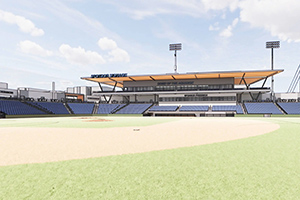
Plans for the proposed stadium call for 5,000 seats, a clubhouse area and a public walking path around its perimeter. Along with hosting baseball and soccer teams, the city would also be able to lease the space or use the stadium for public events.